
Traffic Ticket Records let Illinois drivers instantly confirm citation details, payment status, and court outcomes without endless phone calls. By entering a citation number or license plate into the traffic ticket records search tool, you can view violation descriptions, applicable traffic codes, and any fines or fees owed. The Kane County online portal pulls from the official traffic ticket records database, ensuring the information reflects the latest updates from the circuit clerk’s office.
Traffic Ticket Records also help you track changes such as pending tickets, dismissed citations, or recent payments, all displayed in a clear, user‑friendly format. Whether you need to verify a case status, download a traffic ticket records PDF, or understand the financial breakdown, the portal offers a reliable, public record source. This streamlined approach saves time and reduces uncertainty for drivers managing multiple violations.
How to Search Traffic Ticket Records
Traffic Ticket Records are court case entries created when a traffic citation is filed in Kane County. In addition, consulting official traffic court records records confirms that the official lookup helps a driver find the citation, compare the charge with the driver and date shown on the ticket, and read the court’s current status and amount entries. It serves as a case-history tool rather than a driving-record service or a replacement for the citation. Use the court’s own page so the result comes from the agency that records court filings and payment activity.
Official Search Portal: https://cic.countyofkane.org/Pages/Online-Court-Records.aspx
Steps to Search
- Open the official Kane County Circuit Clerk court-records page and select its public court-record search option.
- If the search page presents case types, choose the traffic or citation category before entering a name, plate, or case identifier.
- Enter the citation number exactly as printed. If the citation search returns no match, use the license plate when that field is offered and remove spacing or letter-case differences.
- Review the result list and open the case that matches the citation number, driver name, and violation date. Do not choose a match from the name alone when several people share it.
- Read the current status and amount entries, then use any on-page instructions for payments or documents. If a certified copy or help with a conflicting result is needed, contact the Circuit Clerk listed at the end of this page.
Traffic Violation Details in Kane County
The court file describes the charge as the court received and processed it. Read the citation first, then use the case entry to check the charge description, legal section, event dates, and current balance. A small wording difference does not always mean a different case, yet unexplained differences should be sent to the Circuit Clerk for comparison with the filed record. A county court case is separate from an Illinois driving record, so a search of one does not replace a search of the other.
Violation Description
The violation description identifies the alleged charge recorded in the court case. It may use shorter wording than the citation issued at the scene. The description also does not by itself show whether the allegation was proved, dismissed, settled, or resolved through another court-approved outcome. The dated case events provide the context needed to interpret that wording.
Applicable Traffic Code
The code entry points to the traffic statute or local ordinance cited in the filing. A code section identifies the law connected to the charge, not the amount due or the court’s decision. If the ticket and the online case list different sections, compare the full citation, charge date, and case number before contacting the court.
Violation Category
A category label helps separate traffic cases from other case types and can prevent a reader from opening an unrelated matching name. The label may come from the court’s index or from the first filing in the case. Read the citation number and party name beside the category because two people can appear under the same name.
Speed-Related Violations
A speed-related entry may show the alleged speed and the legal limit when those figures were filed with the court. The case index alone does not explain how speed was measured or whether the officer supplied supporting documents. Review the citation and any document or hearing entry that the court makes available before reaching a conclusion about the evidence.
Equipment and Registration Violations
Equipment and registration charges may identify the item cited by the court, such as a registration or vehicle-condition issue recorded in the filing. These entries describe allegations tied to the case. They do not settle separate questions about a vehicle’s registration or a driver’s license status.
Multiple Violations
One court case may contain more than one citation or charge. Separate counts can have different outcomes, even when the court treats them under one case number. Read both case-level and count-level entries when the portal shows them. A remaining amount on one count may differ from the case balance displayed near the top of the record.
Traffic Ticket Record Status
Case status shows where the court case stands according to the most recent entry visible in the portal. Labels can differ between court systems and may change as orders and payments are entered. Use the dated event history to understand the label rather than relying on one word in isolation.
A case can show a posted payment and still carry another status label because the court records payment and case events as separate actions. Read the full history before treating a status as proof that every part of the matter is finished. If the label conflicts with a receipt, hearing notice, or written order, keep each record and ask the Circuit Clerk to compare the entries.
Traffic Ticket Record History
Case history shows the court’s recorded sequence of filings, events, decisions, and payments. It is useful for checking what happened after the citation was issued. Some portals show only a summary and selected events, so a missing document does not always mean the event never occurred.
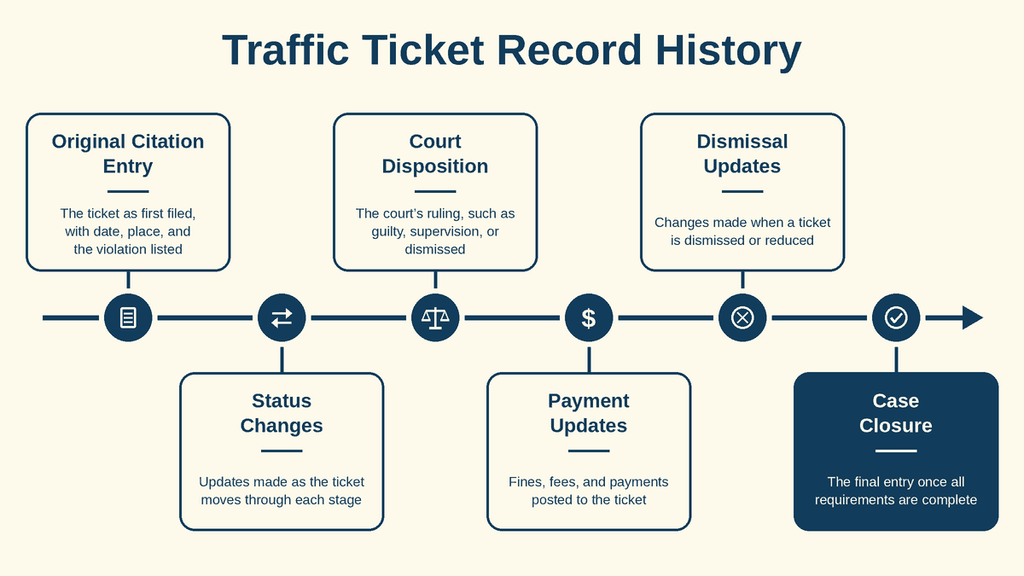
Original Citation Entry
The original entry connects the citation to the court case and usually supplies the starting filing details. The citation date and court filing date may be different because one records the roadside event and the other records the court’s receipt of the case. Read the entry for the court case number, which may become the most reliable search term once the filing is located.
Status Changes
Status changes appear as dated events tied to filings, hearings, orders, or other court activity. Each event reflects an action entered into the case, not a continuous live feed. If the case summary appears behind a newer event, reopen the history and read the entries from oldest to newest.
Court Disposition
The disposition records the court’s decision or another court-approved ending. Its exact legal effect depends on the wording entered by the court. A case marked resolved or closed may still need careful reading of the disposition, especially when the citation carried several charges or the record shows a settlement.
Payment Updates
Payment entries show amounts received and the dates on which the court posted them. Some entries may contain a transaction or receipt reference. Compare the posted amount with the assessed amount and the displayed balance. A receipt held by the driver can help resolve a question when the online payment entry has not yet appeared.
Dismissal Updates
A dismissal update records a court action that ended a cited claim. The event may follow a payment, agreement, or decision made through the court process. Payment by itself should not be treated as proof of dismissal unless the court record says so, because the two entries serve different purposes.
Case Closure
Case closure marks the end of the court’s open case activity. It does not erase the filed record or answer every separate question about court fees, reporting, or driving history. Read the final entries to learn whether closure followed full payment, a dismissal, a judgment, or another disposition.
Traffic Ticket Financial Details
Financial entries in a traffic case show money assessed, paid, credited, or left due according to the court ledger. They do not explain every step behind the calculation. The case entry, payment receipt, and written order should be compared when the figures do not agree.
Listed Fine
The listed fine is the amount entered under the charge for the violation. It may represent a penalty, a proposed settlement amount, or a court-assessed amount, depending on the stage shown in the record. The description of the case event helps show how the court treated that figure.
Court Costs
Court costs are separate from the fine and may include fees or case expenses assessed through the court. The exact total depends on the events entered in the particular case. A driver should not calculate a final amount from the fine alone, since the portal may show costs under separate labels.
Other Charges
Other case charges may appear for fees or amounts tied to court activity. Each line should be read with its date and description rather than merged into the fine. This prevents a cost from being mistaken for a second traffic violation or for a payment already credited.
Total Amount Assessed
The total assessed is the combined amount entered by the court at a particular stage. Later credits, adjustments, or payments can change the balance shown below it. A total from an earlier event may remain visible in the history even after the case reaches a later financial position.
Amount Paid
The amount paid shows money the court has posted against the case. A partial payment can create a paid entry without clearing the full balance. The date matters because several payments may have been recorded, and the court may display each one as a separate event.
Outstanding Balance
The outstanding balance is the amount left after posted payments and credits are applied. A zero balance means the visible court ledger shows no unpaid amount. It does not prove that a separate citation, related case, or other obligation has been resolved. A driver with two similar cases should compare both case numbers before treating the balance as settled.
Online financial pages may not display every receipt, adjustment, or supporting document. For a disputed total, compare the amounts with a receipt and the dated court events. For a filing that requires proof, ask the Circuit Clerk whether a certified copy is needed and what request procedure applies. Do not assume that a saved browser copy has the same legal standing as a certified court record.
Traffic Ticket Record Updates
The court-records database changes when court staff enter a new filing or event. For public reference, official dui records listings indicate that the timing of those entries depends on the action and the court’s processing. A recent event can be absent for a short period, and an amount can change after a payment or order has been posted.
Newly Entered Tickets
A newly issued citation may not appear in the online index as soon as the driver receives it. Filing and data-entry steps occur between issuance and the court’s searchable case entry. If the citation is very recent, keep the paper citation and check again later rather than assuming the ticket was dismissed.
Updated Case Status
A case status changes after the court enters a qualifying event, such as a hearing result or order. The summary may not carry the same wording as the dated history. Open the event list to see what caused the change and when it occurred.
Payment Updates
Payment activity appears after the court receives and posts the transaction. The date shown on the receipt and the date shown in the case may differ. If the case still shows an old balance, compare the names, amount, and case number on the receipt before contacting the court.
Disposition Updates
A disposition update records the court’s decision after the case reaches that stage. The entry may use legal shorthand that differs from the label on the case summary. Read the complete wording and date so the result is tied to the correct citation.
Corrected Record Information
A corrected entry may fix a name, amount, event description, or clerical mistake entered earlier. A correction does not automatically create a new charge, reopen a deadline, or cancel a prior order. The court’s wording controls the effect of each change.
Recently Closed Records
A closed case may stop appearing in a default search list or require an exact citation number. Use the closed-case option if the portal provides one, or search by the full case identifier. A recent closure can also mean that payment and disposition entries were added during the closing process.
Traffic Ticket Record Verification
A sound traffic ticket records verification uses several matching points rather than one partial result. Citation number, driver, date, court, status, and amount should point toward the same case. Any mismatch should be checked against the paper citation and the court’s dated entries.
- Confirming the citation number: compare every letter and digit with the citation. A missing prefix, transposed number, or extra space can send the search to another result or no result.
- Matching driver information: compare the name on the citation with the party name entered by the court. Do not rely on a common name or a similar spelling alone.
- Checking the violation date: confirm the date of the alleged violation rather than the filing, hearing, or payment date. This separates citations issued on different days.
- Verifying court information: check that the court shown on the citation matches the court listed with the result. Venue errors often become visible when the citation and case are placed side by side.
- Reviewing the current status: read the dated event that supports the status label. A recent order may not be reflected in a cached summary that was opened earlier.
- Confirming financial information: compare the assessed amount, posted payment, and remaining balance. Keep the receipt with the citation so each figure can be traced to a date.
Saving a Record Copy
If the portal offers a PDF or print function, save a traffic ticket records PDF or printed copy for your files. It shows what appeared on the page at that time. The file is not a certified court copy unless the court labels it that way, so check the requirement for the task at hand before relying on it.
Attorney Record Requests
An attorney can use the public court-record search for public case details. Files held in a separate attorney case system may not appear in the public view, and a public case index may omit supporting documents. For a legal filing, ask the attorney or Circuit Clerk which record and copy form must be used.
API and Authorized Data Requests
Do not assume the public search page supplies a traffic ticket records API. A third-party service that offers an API is separate from the court unless its materials identify court authorization. Organizations that need court data should ask the Circuit Clerk whether an approved data channel exists for an authorized request.
Privacy and Public Records
Public court records can still contain a driver’s name, case number, charge, and amount. Public viewing does not mean that every item may be republished without limit. Follow any terms or privacy policy posted with the portal, and ask the Circuit Clerk before collecting records in bulk or redistributing them.
Traffic Ticket Record Availability
Not every court file or filed document appears in the public online view. The search index may cover many routine traffic cases, yet recent filings, old cases, restricted material, and supporting documents can follow different handling rules. The official court page is the best starting point for judging what the portal can show.
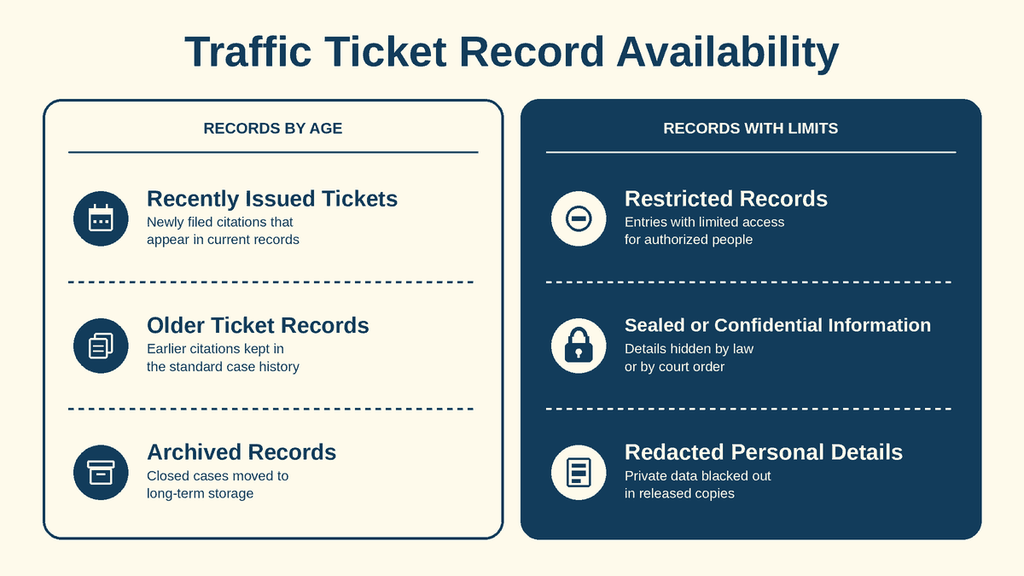
Recently Issued Tickets
Recent tickets may take longer to appear because the citation must be filed and entered into the court system. An empty search for a ticket issued days earlier may reflect that delay. Keep the citation and return to the official page after the filing has had time to appear.
Older Ticket Records
An older citation may require an exact case number or a different date range if the default search does not locate it. Older records can sit outside the portion of the index covered by the current portal. If the exact citation fails, the Circuit Clerk can check whether a court file exists and what request method applies.
Archived Records
An archived file is a court record kept outside the current active case view. The public page does not promise that every older traffic case remains searchable online for a set period. Ask the Clerk about archive retrieval rather than assuming an absent online result means the case was never filed.
Restricted Records
Some records may carry court restrictions or require a party, attorney, or other authorized person to obtain them. The public case index might still show the case number without showing every document. The visible case caption does not prove that the full file can be viewed online.
Sealed or Confidential Information
Sealed and confidential material may be omitted from the public page or shown only through a limited case entry. The court decides which material falls under those rules. A missing document should not be treated as proof that it does not exist, particularly when a case history references a sealed filing.
Redacted Personal Details
Some personal details can be hidden when the public copy is prepared. A redacted entry may still preserve the case number, charge category, event dates, or amount. Compare the visible fields with the citation and contact the court if the redaction prevents a needed match.
Case retention and online posting are separate matters. A traffic ticket records expiration date is not a promise that the online entry will remain visible for a fixed period. If a case has aged out of the public index, ask the Circuit Clerk about the current file and whether a certified or ordinary copy must be requested.
Kane County Traffic Ticket Search Problems
Most failed searches result from an incomplete identifier, a filing that has not yet appeared, or a mismatch between the ticket and the selected court. Work from the full citation number and verify each result against the driver name and violation date. A clear record should agree across those fields.
If the exact citation still produces no useful result, contact the Circuit Clerk with the citation number, driver name, violation date, and amount shown on the ticket. Those details allow staff to identify the correct file without relying on a partial search. Keep any paper citation, receipt, notice, or order with the request because each document may supply a field missing from another.
Contact Details
Contact the Circuit Clerk for a search mismatch, a request form, a document copy, or a question about a posted payment. Have the citation number and related case details ready so staff can locate the correct record. Provide the filing date or payment reference when available to narrow the search. Check the case information carefully before submitting a follow-up inquiry. For unresolved issues, ask the clerk which department handles the matter and whether additional documentation is required.
Frequently Asked Questions
Traffic Ticket Records give drivers a clear view of citations, court decisions, and any fines owed. Accessing these records helps you verify details, plan payments, and avoid surprises when renewing a license. The official Kane County portal offers up‑to‑date information straight from the court, ensuring accuracy and legal compliance. Knowing how to search, request, and interpret these entries saves time and prevents costly mistakes.
How can I view traffic ticket records in Kane County?
Visit the Kane County Circuit Clerk online portal, enter the driver’s name or license number, and click Search. The system displays each citation, the charge, the filing date, and current case status. Review the amount due, payment options, and any upcoming court dates. If details look incorrect, use the contact phone number to request a correction.
What steps are needed to request a traffic ticket records PDF?
Log in to the online court records page, locate the desired ticket, and select the Download PDF button. Save the file to your device for personal records or to share with an attorney. The PDF includes the citation, court rulings, and payment history, making it easy to reference during disputes.
Can I search traffic ticket records by license number?
Yes. Choose the “License Number” field on the search form, type the full number, and submit. Results list every ticket linked to that license, showing dates, offenses, and fines. This method quickly identifies outstanding balances and helps you track repeat violations.
Is there a fee to access traffic ticket records online?
The online search tool is free for basic information. However, printing, certified copies, or detailed case documents may require a small payment. Fees appear on the checkout page before you confirm the request, so you know the cost ahead of time.
How do I verify the status of a traffic ticket before paying?
Enter the ticket number on the portal’s status checker. The page shows whether the case is pending, scheduled for court, or already resolved. If the status is “Pending,” you can see the next hearing date. For “Resolved,” the record lists the final fine and any payment already recorded.